Wildlife economics · Park County, Montana
The wild
pays the bills.
Nobody drives to Gardiner for the parking. They come for the bison, the trout, the wolves and the mountains, then they buy dinner, a room, a guide and a pair of socks. Here is what that adds up to.
Chapter 1 · Park County
An estimated half a billion dollars a year.
What visitors, Montanans included, spend in Park County each year, at Yellowstone's only year-round entrance (coalition estimate, 2025).1
How we estimate it
The state measures only out-of-state visitors, so we built our own estimate three ways. Lodging: Park County's 4% lodging use tax ($4.48 million in 2025) implies about $112 million in room receipts, and lodging is about 22% of visitor spending in ITRR's Park County figures, which gives about $513 million. Out-of-state plus Montanans: ITRR's out-of-state spending brought forward to 2025, plus an estimated share of Montanans' in-state travel, gives about $577 million. Local business sales (2022 Economic Census) give about $500 million. The three land between $450 million and $650 million; we say half a billion.
Total economic activity from out-of-state visitors alone (2019/2021 average), counting only what ITRR can measure.2
Park County jobs supported by that visitor spending.2
Of Park County jobs are in food, lodging and recreation: double the state average.3
Ask the place you ate dinner last night what a winter on locals alone looks like.
Chapter 2 · The lodging tax
More than $8 million a year to Helena.
Potholes not included.
Every night a visitor sleeps in Park County, the state collects lodging taxes: a 4% use tax and a 4% sales tax. Together that comes to more than $8 million a year from this one county.4
The use-tax half alone hit a record $4.48 million in 2025, more than double 2019.4 A slice of it comes back to the region, as tourism marketing.
Picture any CEO who spent the entire budget on advertising and not one dime on the product. The board would have them out by lunch. Our product is the wild: the elk, the trout water, the open country. Marketing it is the easy part. Somebody has to invest in it, too, and right now that somebody is us.
We are not mad. We would just like a pothole named after us.
Chapter 3 · June 13, 2022
When the park closes, our towns stop.
The 2022 flood washed out the North Entrance road. That summer, Gardiner's July-to-September lodging tax fell 91%, to $34,171.5 Same town, same motels, same river. Just no way into the park.
Chapter 4 · Why they come
They come for the wild.
The gift shop is a bonus.
of Montana's out-of-state visitors are drawn by mountains and forests.
of Montana's out-of-state visitors are drawn by open spaces.
of Montana's out-of-state visitors are drawn by rivers.
Montana, 20256
Of Park County vacationers name wildlife as a reason for the trip, against 34% statewide (2017-2021 average).7
Of visitors through the North Entrance at Gardiner came mainly to see wildlife (2016), tied with scenery.8
A year in visitor spending that exists only because of Yellowstone's wolves (2021, three states, direct spending only).9
That is not a price on a wolf. That is the price of not having one.
Chapter 5 · Where the money lands
The biggest line item in Park County
isn't gas. It's guides.
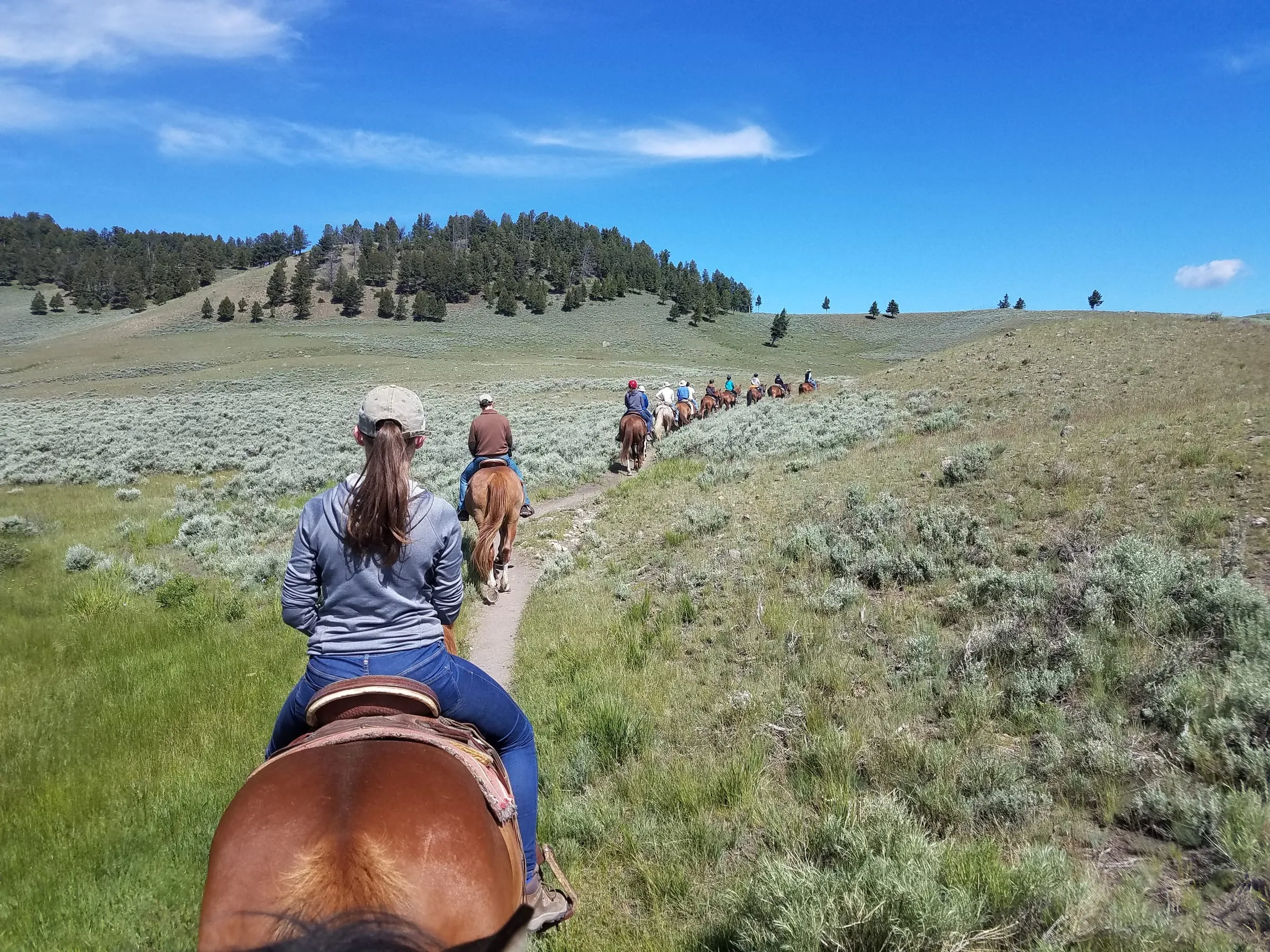
Out-of-state visitor spending in Park County by category, 2019/2021 average. Statewide, fuel comes first. Here, people pay someone who knows where the fish are.10
- Outfitter, Guide
- Gasoline, Diesel
- Restaurant, Bar
- Hotel, Motel
- Groceries, Snacks
- Rental Cabin, Condo
- Retail Sales
- Campground, RV Park
- Licenses, Entrance Fees
- Made in MT
Chapter 6 · The neighbor
Yellowstone had 4,762,988 visits last year.12
Its second-busiest year on record. In 2024 (latest NPS report), park visitors spent $709.7 million in the gateway communities around it, supporting 6,563 jobs.14
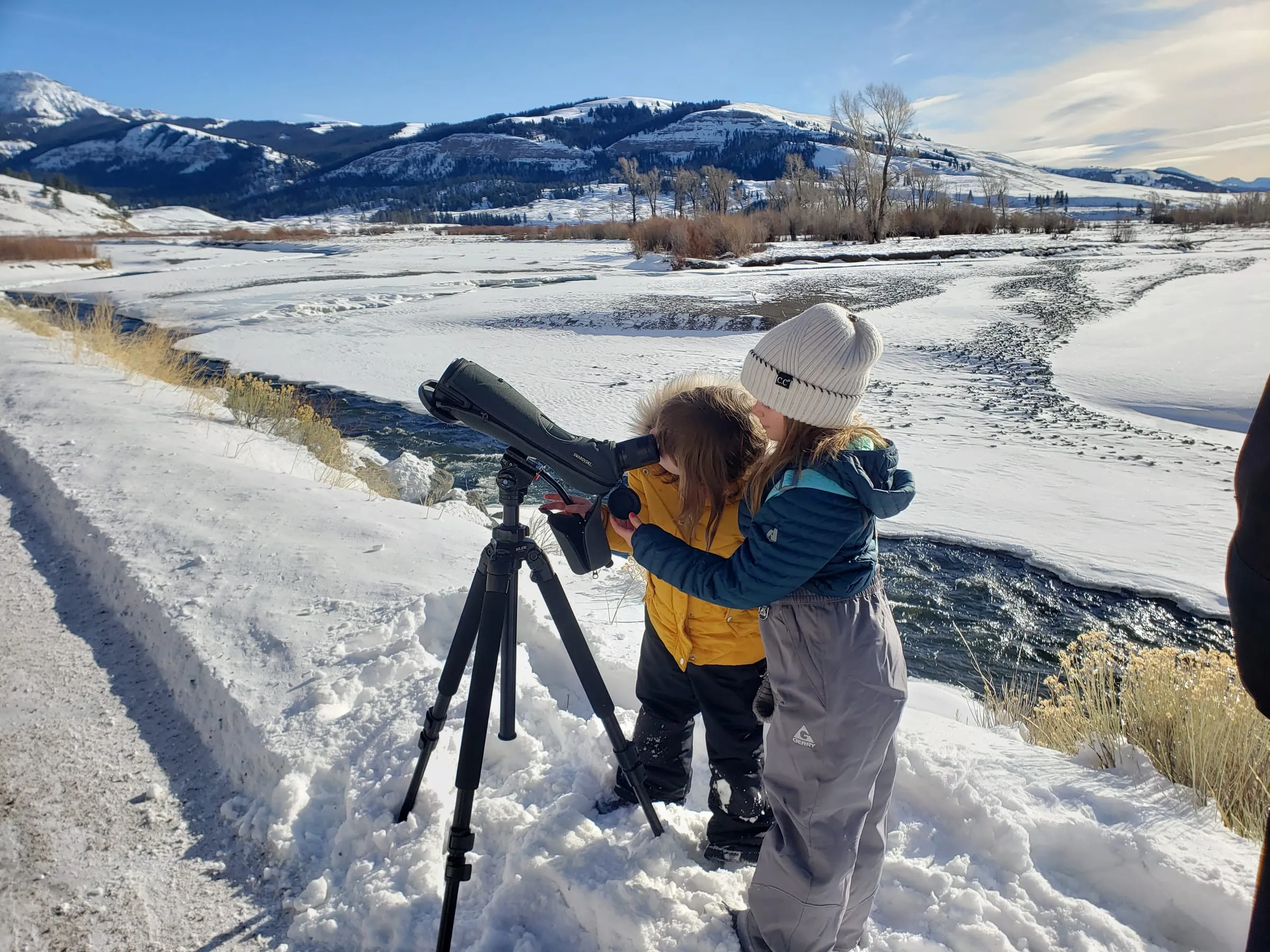
Of those visits came through the North Entrance, right here at Gardiner: nearly one in four, at the only entrance open to cars all year. NPS monthly figures for 2025.13
Chapter 7 · Montana
The biggest employer in the state
is a visitor with a fishing rod.
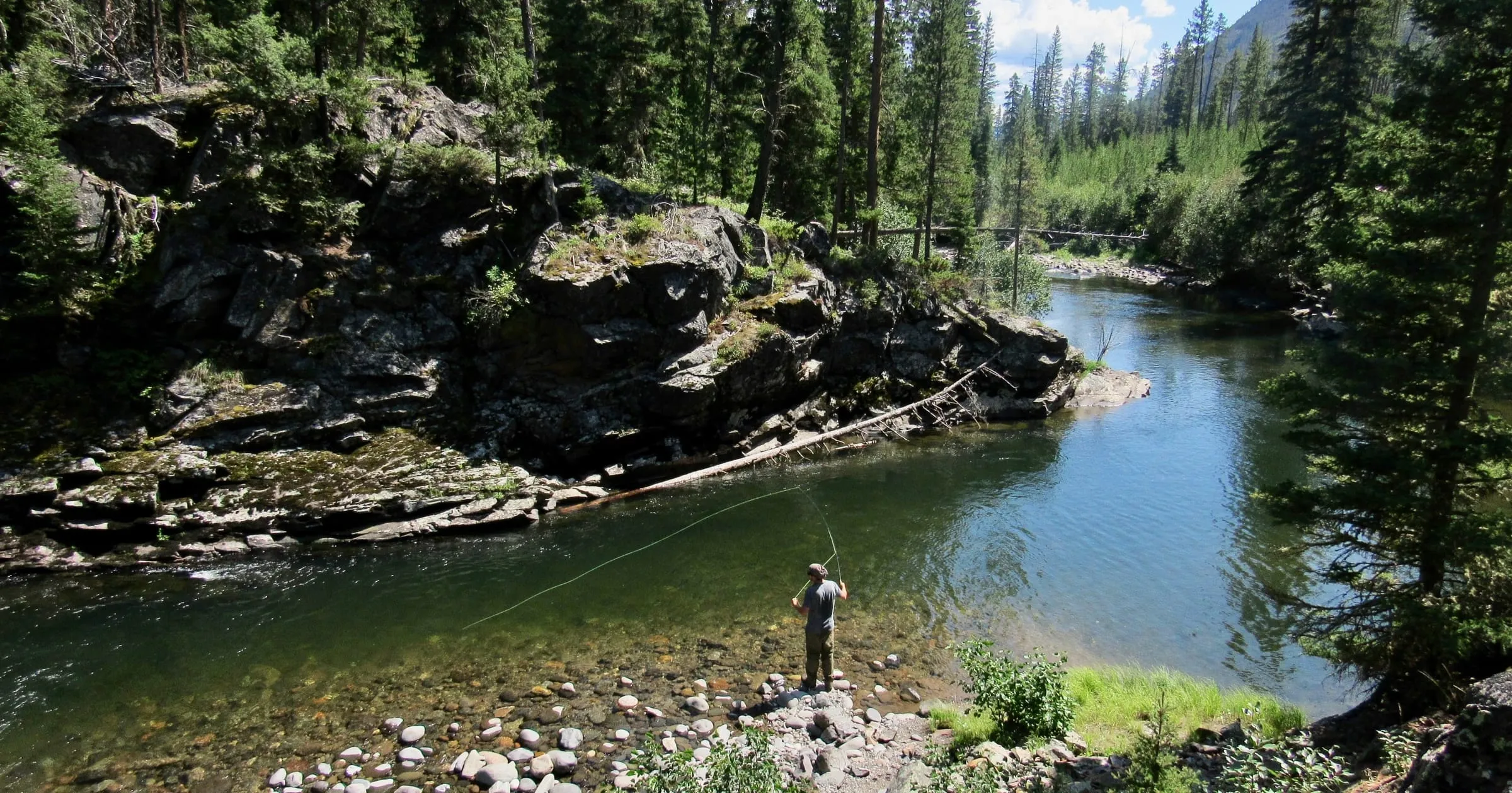
Out-of-state visitors in 2025.15
What they spent here.15
Of Montana jobs: travel and tourism is the state's largest employment sector.6
Outdoor recreation's share of the state economy, 2024
- Hawaii
- Alaska
- Montana
- Vermont
- Wyoming
- United States
Bureau of Economic Analysis16
Chapter 8 · Same valley
Ranches, hunting camps and trout water.
One neighborhood.
Park County runs on cattle, on hunting season and on summer visitors, and has for a long time. The same open country that keeps a ranch working keeps a guide booked and an elk camp full. Nobody here has to pick a side.
Farms and ranches in Park County, on 736,194 acres, selling $43.7 million in 2022 (census every 5 years).17, 17
Of Park County is national forest: public land, open to everyone who hunts, fishes, hikes or grazes it.18
What anglers spend in Park County in a year: 135,434 angler days (2023, latest survey) at statewide spending per day (coalition estimate).19, 20
Of Park County turned into housing from 2000 to 2021. That pressure lands on the ranch, the winter range and the trailhead alike.24
Clean, cold water is the inventory.
The Yellowstone between Springdale and Gardiner drew 111,144 angler days in 2023, more than any other water in the county.19 Fishing alone brings Park County about what its farms and ranches sell, and both depend on the same river. Statewide, anglers spent $1.27 billion in 202421 and hunters $389.2 million in 2017 (latest spending study).22
In August 2016 a parasite-borne disease killed thousands of whitefish and FWP closed 183 miles of the Yellowstone to all recreation. Park County lost an estimated $360,000 to $524,000 in a few weeks.23 Keeping the river clean and cold is not a favor to the trout. It is the business plan.
We think the numbers make the case for keeping the whole valley wild and working: open land, clean water, habitat with room to roam, a fair chase, and wildlife policy built on science.
What local businesses told usSpend it with the herd
Be a regular at the places that look after this one.
Travel and tourism is Montana's biggest employment sector, and it runs on wild country. The fastest way to put your vacation to work for the wild: spend it with a pledge business.
Sources
- Coalition estimate of Park County visitor spending, Montanans included (2025), from Montana Department of Commerce lodging tax collections and ITRR visitor-spending patterns (method in the note under the figure), Wild Livelihoods, 2026-10.
- Montana Travel Regions & Counties - Economic Contribution of 2019/2021 Averaged Nonresident Travel Spending, Institute for Tourism and Recreation Research (ITRR), University of Montana; author Kara Grau, 2023-03.
- Economic Overview of Park County (County Overview Profile 2024), Montana Department of Labor & Industry, Research and Analysis Bureau, 2024.
- Gross Lodging Tax Revenue, Yellowstone Country counties (YELLOW_Sept26.xls), Park County sheet, Montana Department of Commerce, Office of Tourism and Business Development, 2026-09-25.
- Gross Lodging Tax Revenue, state, region and CVB (REG-CVBS_Sept26.xls), Gardiner sheet, Montana Department of Commerce, Office of Tourism and Business Development, 2026-09-25.
- The Montana Travel Industry - 2025 Summary, Institute for Tourism and Recreation Research (ITRR), University of Montana; author Melissa Weddell, 2026-06.
- Greater Yellowstone Wildlife-Related Activity Valuation Study, Figure 11 (ITRR nonresident survey data), RRC Associates and ITRR, published by Wild Livelihoods Business Coalition, 2022.
- Greater Yellowstone Wildlife-Related Activity Valuation Study (citing RSG 2016, Yellowstone National Park Visitor Use Study: Summer 2016), RRC Associates and ITRR, published by Wild Livelihoods Business Coalition, 2022.
- Economic Impact of Wolf-Related Visitation to Yellowstone National Park: An Update of 2005 Estimates (in Greater Yellowstone Wildlife-Related Activity Valuation Study), Bioeconomics, Inc. (Neher, Duffield, Patterson), in a study by RRC Associates and ITRR published by Wild Livelihoods Business Coalition, 2022-05.
- Montana Travel Regions & Counties - Economic Contribution of 2019/2021 Averaged Nonresident Travel Spending (Park County page), Institute for Tourism and Recreation Research (ITRR), University of Montana; author Kara Grau, 2023-03.
- Yellowstone National Park: Park Facts (Top 10 Visitation Years), National Park Service, 2025-04-18.
- News release: Yellowstone 2025 visitation (26004), National Park Service, Yellowstone National Park, 2026-03-17.
- Yellowstone Detailed Report (IRMA report "YELL Detailed and Seasonal"), monthly editions January-December 2018-2025, Recreation Visits row, North entrance station column, National Park Service, Visitor Use Statistics (IRMA STATS), 2026-10-13.
- 2024 National Park Visitor Spending Effects: Economic Contributions to Local Communities, States, and the Nation (Science Report NPS/SR-2025/353), Table 4, National Park Service (Flyr, Stockmoe, Cullinane Thomas, Koontz, Huber), 2025-09.
- 2025 Estimates - Nonresident Visitation, Expenditures, and Economic Contribution, Institute for Tourism and Recreation Research (ITRR), University of Montana; author Kara Grau, 2026-06.
- Outdoor Recreation Satellite Account, U.S. and States, 2024 (BEA 26-13), state tables, Table 1, U.S. Bureau of Economic Analysis, 2026-03-05.
- 2022 Census of Agriculture County Profile: Park County, Montana, USDA National Agricultural Statistics Service (data source for Headwaters EPS Agriculture report), 2024-02.
- Public land ownership in the United States (interactive map, county tooltip), Headwaters Economics (data: USGS Protected Areas Database of the United States, PAD-US), updated 2025-09; read 2026-10-13.
- 2023 Statewide Angling Pressure, Appendix A: annual pressure by water body, Montana Fish, Wildlife & Parks, 2024.
- Coalition estimate: FWP 2023 Park County angler days x BBER 2024 spending per angler day, by residency, Wild Livelihoods, 2026-10.
- Economic Impact of Fishing in Montana, 2024 season (study for the Legislature), University of Montana Bureau of Business and Economic Research, for Montana Fish, Wildlife & Parks, 2025-08.
- The Value of Montana's Outdoors, Headwaters Economics with Business for Montana's Outdoors, 2019-09-03 (page modified 2026-10-01).
- Report: Yellowstone River closure cost Park County $360,000 (citing ITRR's preliminary estimate), Flathead Beacon, 2016-09-23.
- Paradise Valley open space initiative falters amid political priority reversal (news excerpt citing Headwaters Economics analysis of property tax data), Headwaters Economics (news excerpt; original outlet not named on the page), 2025-12-09.