Where this started
In August 2021, following new state laws, Montana Fish, Wildlife and Parks (MTFWP) commissioners introduced new wolf hunting regulations. The law did not require it, but the commissioners voted 3-2 to replace the limited quota of two wolves in the wolf management units (WMUs) next to Yellowstone with a potential of 82 wolves in Region 3, possibly taken by as few as five individuals, with no limit in WMUs 313 and 316.
A group of local businesses spent that year raising public awareness. The ask was simple: base wolf quotas next to the park on the resident wolves that actually live in WMU 313.
In August 2022, after hearing from Park County businesses and individuals, the FWP commissioners voted to combine WMUs 313 and 316 into one unit, 313, and set a quota of six wolves. We are grateful the commission heard a civil argument and answered with a compromise that recognizes how big a role tourism plays here. We still welcome every comment and a civil discussion on this topic.
A small sliver of land, a big share of the harvest
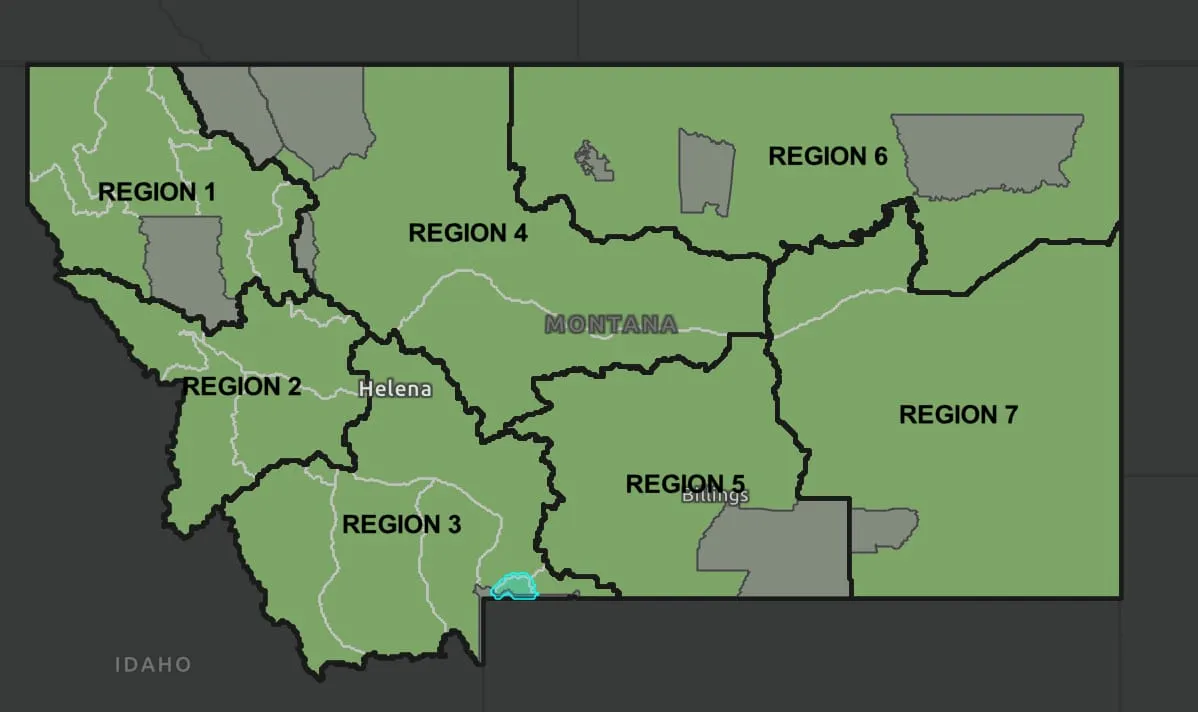
WMUs 313 and 316 (highlighted) are about 0.5% of Montana’s land area, yet they produced more than 10% of the state’s wolf harvest. The reason is not complicated. These wolves live primarily in Yellowstone (more than 90% of the time) and den and raise pups there. They are used to people. When they leave the park in winter to follow prey, they are easy targets, especially in WMU 313 around Gardiner, where they are easy to see and not afraid of people. It is not unusual for a few hunters to sit in a vehicle with the windows down, listen for howls, then reposition on dirt roads.
Yellowstone has averaged about 100 wolves park-wide. Conservatively, half of them might move in and out of WMUs 313 and 316. Against the 2020 Wolf Project count of 123 wolves, 20% were killed in the 2021-2022 season, and depending on the published 2021 population, that share could be higher.
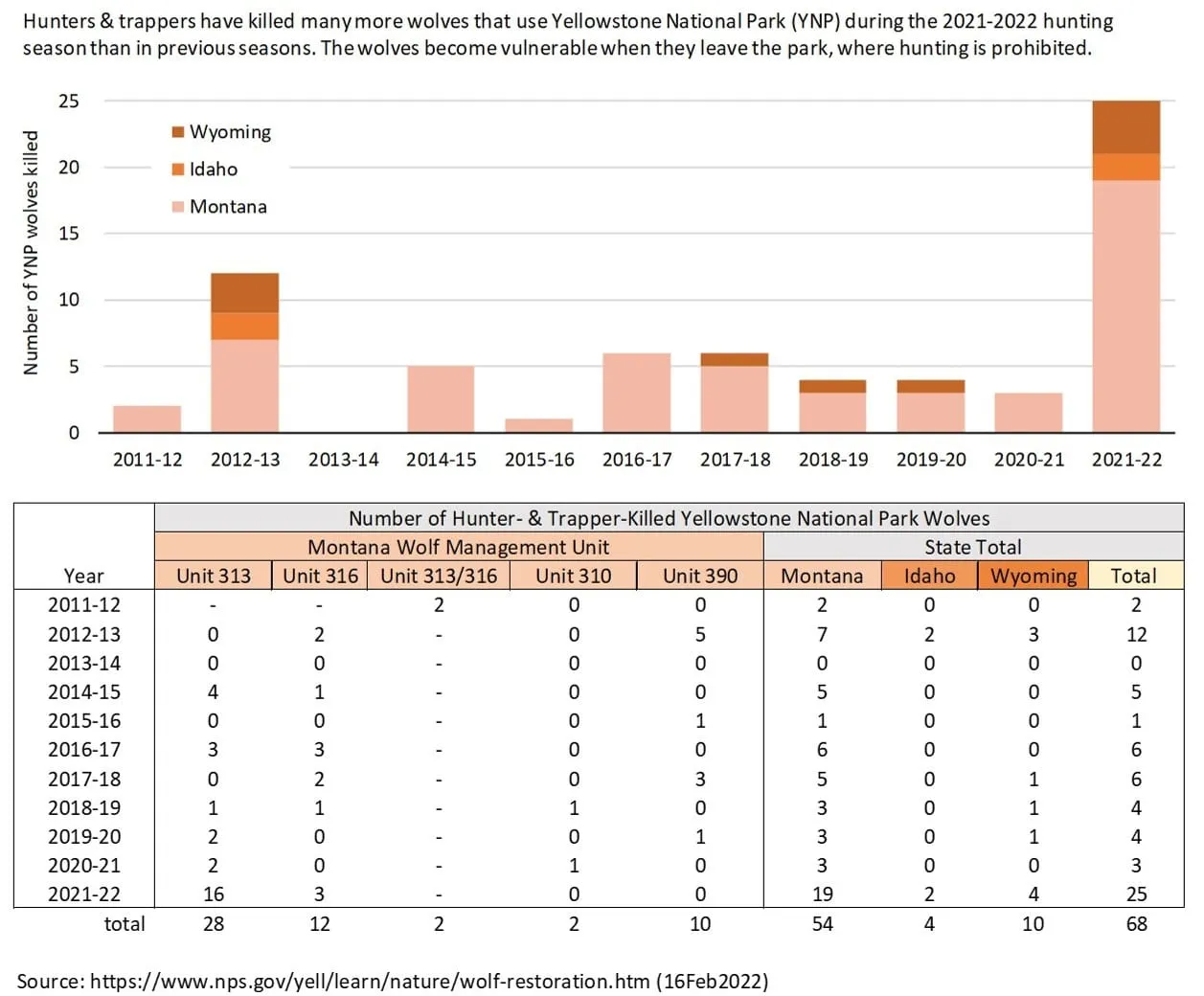
As of January 23, 2022, 17 wolves had been taken in WMU 313, roughly 10% of the statewide harvest, from a unit that is 0.17% of the state’s area. One wolf is 0.22% of the statewide review threshold of 450 wolves. So by basic math, if the reduction were spread in proportion to area, WMU 313 would get one wolf. Region 3 is a vast piece of southwest Montana (see this map); WMUs 313 and 316 are less than 4% of it, mostly national forest that has to serve many uses, not private land.
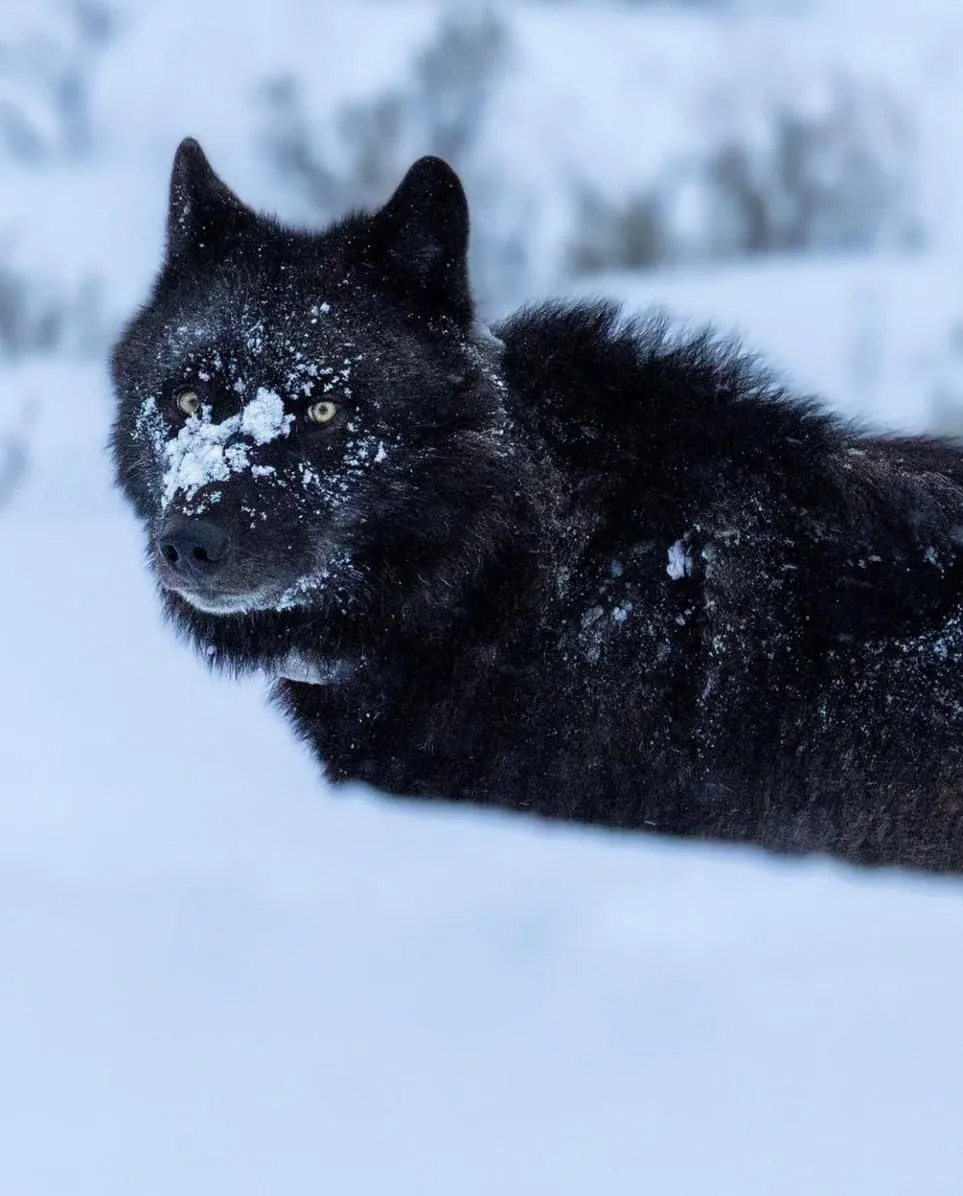
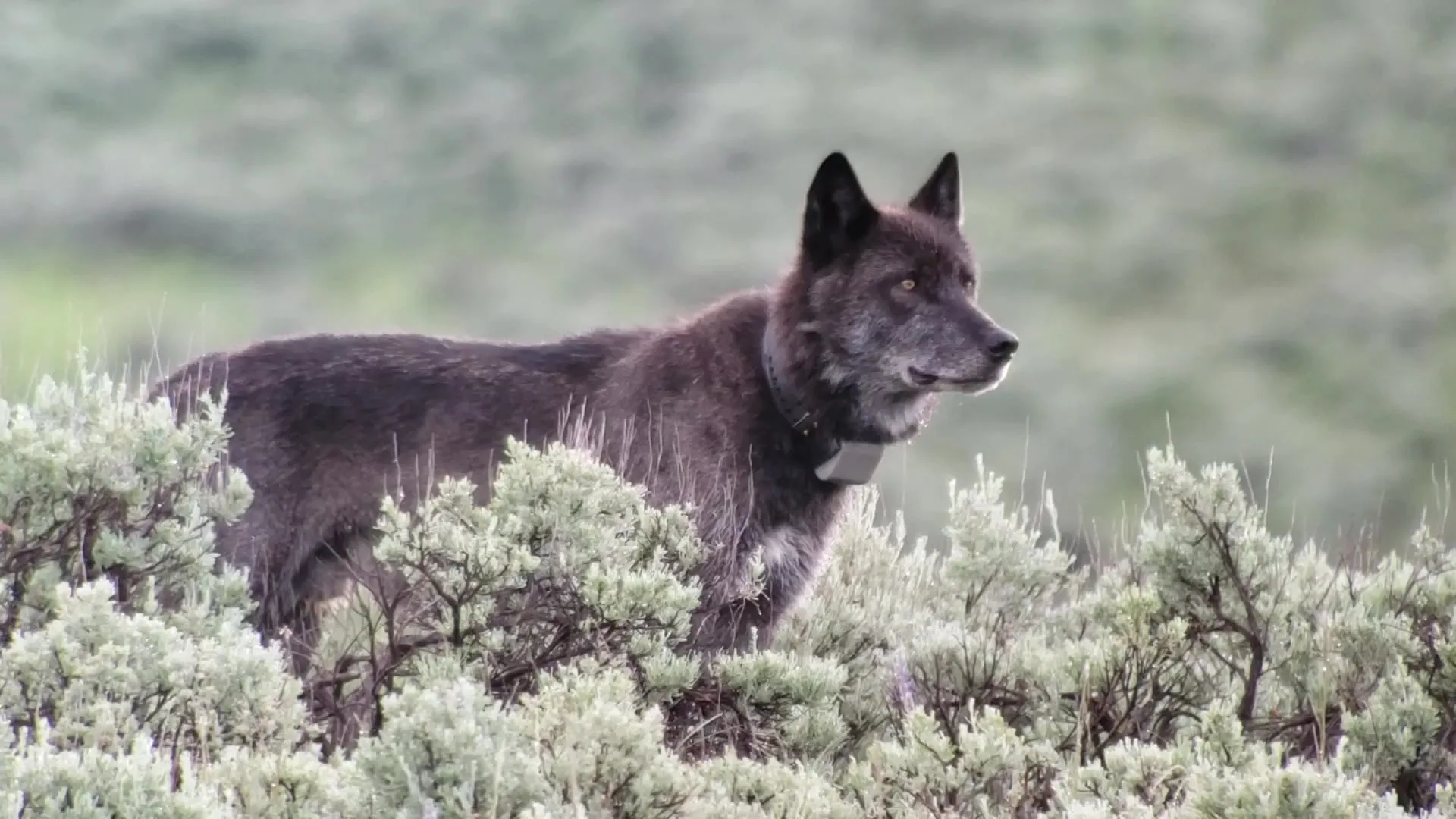
Wolf 1233 on Yellowstone’s Blacktail Plateau in January 2022, weeks before it was shot in WMU 313 after the January 28 FWP meeting that did not close the season as we had asked. Photo: Nick Zimmer.
On January 28, 2022, apparently in response to wide complaints that an outsized share of the Region 3 harvest was coming from WMU 313, the commission held a special meeting. It voted to close Region 3 once 82 wolves were taken, but it did not close WMUs 313 and 316. A motion to do that was made and, after an odd turn of events, dropped.
What we are working toward now
With small quotas now set separately for WMUs 313 and 316 (three wolves each in the 2025-26 rules), we are working for a civil, scientific discussion about how many wolves actually live in 313, so a quota can rest on field data and a clear definition of what it means to count a population, whether of people, wolves or elk. Reasonable people can agree on wanting to know how many elk, people, cattle, wolves and grizzlies actually occupy a landscape, so decisions rest on reality rather than best guesses.
The collar data shows Yellowstone packs spend only a fraction of their time outside the park, and yet the effect of human-caused deaths shows up in pack dynamics in the years after. For businesses that sell quality wildlife experiences, the burden of proof is on MTFWP to produce accurate population estimates for 313 that do not double count residency (a double tax, if you like), and to show the effect of quotas on wolves that are not residents.
Why wolves are on our books
Customers who travel to Montana and spend money here bring outside money into the state, which earns a higher margin than local sectors that export goods. The 2021 quota changes in WMUs 313 and 316 set up the chance that a handful of people could affect the viability of the Yellowstone wolf population and do lasting harm to the local economy. Many of the commissioners are not from our area, and there was no need to apply their region’s high quota to our economy.
Like them or not, wolves are a local economic mainstay. They are the stated main interest of most of the recreational visitors who come through Yellowstone’s North and Northeast entrances. For many of our members, trout and wolves are part of the supply chain. But it is not about two species. It is about a dynamic, diverse, healthy ecosystem, which takes hard work, compromise and showing up. We doubt visitors would pick a national park full of grazing bison over one full of wildlife doing what wildlife does.
- In 2021, 1,251,912 visitors came through the northern entrances. Livingston, Paradise Valley, Gardiner and Cooke City serve them and earn tens of millions of dollars doing it.
- The top reason visitors come to Yellowstone’s northern gateways is to see wildlife on the Northern Range, and they say they come primarily to see wolves. They spent approximately $80 million in the first 10 months of 2021 (based on wolf-dependent visitor spending in 2005 from Duffield et al., 2008, adjusted for inflation and visitor growth). See this report and this study.
- A wolf hunting license costs between $10 and $50 per wolf.
Put it all together and wolves bring at least $82.7 million a year in spending by visitors who would not otherwise have come (2021, Montana, Wyoming and Idaho, direct spending only), according to the 2022 Park County Tourism Study (Neher, Duffield and Patterson, Bioeconomics).
We would welcome a seat at the policy table, but we believe state and federal scientists should be the ones telling us what it takes to keep wildlife populations sustainable. If that hurt our businesses, so be it. We just ask that business voices be heard alongside the other stakeholder groups.
Hunting, ranching and tourism
When Yellowstone was established in the 1870s, tourism, hunting and agriculture stood on roughly equal footing here, and many locals worked in all three. Many still do.
The press and social media often suggest that ranchers and hunters oppose wolves and that tourists and newcomers from California support them. It is more complicated than that. Ranchers in most of Park County have learned to live with higher wolf quotas where they operate while allowing for low quotas next to Yellowstone. Now, because of FWP’s decision, they face the federal relisting of wolves, which would bring more wolves into their area.
Livestock losses to predators are counted in Montana and can inform the debate. In 2019 the Montana Livestock Loss Board paid $82,450 to 32 livestock owners for confirmed or probable wolf kills statewide. In Park County, of which WMUs 313 and 316 are a small fraction, livestock losses in 2021 came to $18,000 across the whole county.
We fully support compensation for wolf predation. Living with wolves here has real costs, and the price of local agricultural goods does not reflect them. We support talks about higher compensation that covers more than the value of the animal lost. Many of our members are agricultural producers themselves. Still, the commerce data shows that coexisting with wolves is worth much more to our local economy than agriculture. Lodging receipts alone (about $112 million in 2025, from the 4% use tax) are more than two and a half times what the county’s farms and ranches sold in 2022, and all visitor spending is roughly ten times. Both recreational tourism in all its forms, hunting and fishing included, and agriculture deserve recognition in wolf policy.
We are not against hunting. Our coalition includes members from the hunting and fishing industry, and many who hunt to fill the freezer. We support fair chase and subsistence hunting. Public hunting will be a key tool in managing wolves, with the North American Model of Wildlife Conservation as the guide toward science-based population objectives. Coexisting with wolves in landscapes full of people is hard, given livestock losses and the elk numbers that sport hunting, also a source of revenue, depends on. Even so, the commerce data suggests hunting revenue in southern Park County is a small part of non-consumptive recreation revenue such as wildlife viewing in the same area. We support better efforts to measure both.
What the elk numbers say
Settlers who arrived before the 1870s, when wolf poisoning took off, described huge herds of elk, 5,000 at a time, and other ungulates throughout Paradise Valley north of the park (Mammals of Yellowstone, Whittlesey et al.). And wolves. Wolves and ungulates were abundant together across the Greater Yellowstone.
After wolves were mostly wiped out, elk counts began, and the numbers fell from the 1930s on for several reasons, commercial hunting among them (Yellowstone Wolves, University of Chicago Press, Smith et al., 2021). As policy shifted toward more natural management, partly thanks to hunters, elk climbed from the late 1960s until forage became a problem for the livestock industry. Montana added hunting tags, but even with a record harvest in 1991 the numbers kept climbing, then dropped just before wolves were released in 1995. Ranchers and tourists would agree that 20,000 elk on the Northern Range was a one-sided benefit.
After reintroduction, wolves were one of many reasons elk numbers fell, to what looks like an equilibrium among wolves, elk and human harvest. Drought, fire, cougars and grizzlies matter too. As the book puts it: “There is little doubt that wolves have contributed to the recent decline of the northern elk herd. What is in doubt is the size and timing of that contribution.” (p. 187). Current data suggests wolves kill about 10% of the adult northern herd a year, and it has rarely topped 20% across all ages.
North of the park, elk have climbed since 2011, to the point that Paradise Valley ranchers have worked with FWP to expand elk harvest and seasons because of disease (elk carry brucellosis, among others) and lost pasture.
If anything, hunters have the edge. Bull-to-cow ratios are much better inside the park, and Yellowstone acts as a safe haven that spills over to the hunter’s benefit. As one outfitter put it: “The problem in Paradise Valley isn’t that there aren’t enough elk to hunt, it’s that there aren’t enough bulls.” You cannot enjoy what Yellowstone’s management produces and be angry about wolves in WMU 313 at the same time. And if wolves are relisted, WMU 390, where most of the ranching happens here, goes back to many more wolves.
We believe the compromise is obvious: a conservative quota in WMUs 313 and 316, and the current quota everywhere else.
Our recommendations
These are starting points for a healthy conversation about wolf management in the Greater Yellowstone.
Everyone at the table. Tourism, agriculture and hunting, along with the general public. A detailed 2005 study found visitors spend, conservatively, $35.5 million a year (2005 dollars) at gateway businesses to see wolves. Our 2022 study puts it at at least $82.7 million a year in direct visitor spending across Montana, Wyoming and Idaho (2021). We have also gathered what is already known about the tourism economy here, and why diverse wildlife matters to it, on our economic data page.
Manage for a sustainable, natural wolf population for Yellowstone, rather than for personal values or for the individual animals that capture the public’s imagination. Wolf numbers swing with food (mostly elk on the Northern Range), other wolves (roughly 40% of annual deaths) and disease, among other things. Breeding varies year to year and depends on pack size and social structure, such as the death of an alpha. Good quota management would weigh not just how many wolves are taken, but which ones. Some ideas:
- Take no more than 5-7% of the pre-hunt number of wolves living primarily in Yellowstone each year.
- Take no more than 20% of the wolves in any one Yellowstone pack.
- Take no more than 15% of the radio-collared wolves living in Yellowstone.
- Use the 24-hour closure already used for some ungulate species to keep wolf harvest sustainable too.
Drop the “Yellowstone wolf” versus “Montana wolf” rhetoric and work as federal and state neighbors. In the past, Montana and Yellowstone biologists agreed a pack counts as a park pack if it spends more than 50% of its time in the park and dens there. One researcher working in Yellowstone describes how the park counts its wolves:
“We are lucky that hardly any packs along MT are even close to that divided. They are usually more like 90-95+% in YNP and 5-10% in MT, or less. The Phantom Lake pack didn’t have any collars this year but we suspect they were more like 70/30 in and out of YNP. But combining all northern range packs, we still get to the ~90-95% range altogether. For lone wolves we look at their movements the previous few months and determine if they were still using YNP almost exclusively or if they had left the park study area before being harvested. Basically we try to look at the day of the harvest and ask, if today was Dec 31 would this wolf count as part of the official census. And to some people asking how we can tell. We put lots of time into getting full pack compositions with color, age and sex of every wolf. Once we know where a wolf is harvested that usually narrows it down to 1-3 packs and then we just see which one(s) are around based on collars, and match up the individuals. A double check is done that the same wolf is missing by finding them from the ground or flights.”
With this much at stake for Park County, Montana FWP needs the same rigor when it talks about a “Montana wolf” that spends part of its time in WMUs 313 and 316.
Put elk management on the table, with science. Elk carrying capacity should drive the debate. With today’s tools nobody can know the natural carrying capacity of Paradise Valley before European settlement, commercial hunting and tourism began in the mid-1800s. (Written records from the 1860s, before the push to exterminate wolves, describe 5,000 elk near Emigrant Gulch, with wolves around too.) Government counts from the 1930s to today show elk hit the same lows in the 1970s, before reintroduction, that they run at now. More hunting in the 1980s, prompted by forage losses, did not bring the numbers down.
Few who look at the data would deny that wolves affect elk numbers, and that this has affected hunting outfitters. Meanwhile ranchers want fewer elk locally, and wolves drive local tourism. Policy cannot tilt toward the hunting economy alone; it has to include everyone affected by other species. People and wolves both benefit from elk. People benefit from wolves. Ranching benefits when wolves take elk (disease control, less forage loss). Paradise Valley elk outfitters note the issue outside the park is not a lack of elk but the ratio of bulls to cows. Inside the park the ratio is higher, and outfitters benefit from the overflow of animals that do not face hunting, only wolves. Let’s start the conversation about fair use of wildlife there.
In sum
FWP’s decision to remove the two-wolf limit in WMUs 313 and 316 ran counter to the state’s own stated goal of strengthening Montana’s economy. When it comes to recreational tourism, hunting included, we believe the non-consumptive benefits of wolves, even after counting their effect on elk, far outweigh the economic gain of hunting wolves in WMUs 313 and 316.
We are not part of anyone else’s statewide or federal wolf campaign. Our focus is WMUs 313 and 316 only. We asked state legislators, the governor’s administration and above all the FWP Commission to recognize that one size does not fit all, that local needs belong in regulation and management, that state and federal scientists rather than politics should lead, and that Yellowstone Gateway businesses, which create jobs, pay taxes and span the whole economy, deserve a voice in both consumptive and non-consumptive stakeholder groups. Our specific ask was to return the quota to two wolves in WMUs 313 and 316, or to commission a study agreed on by state and federal scientists that would secure the long-term viability of the wolves that live primarily in Yellowstone.
Lower harvests in the transition zone around the park would keep wolves for public viewing, support the local economy, and keep natural wolf behavior and social structure intact inside Yellowstone. A conservative harvest near the boundary, with less conservative harvests farther out in Park County if those neighbors choose, could take much of the heat out of this debate, and elk numbers and elk hunting could carry on at today’s targets.
We asked FWP commissioners, whose agency earns revenue from lodging, a category driven by people who come to watch wildlife, to recognize that higher quotas in WMUs 313 and 316 put our diverse local economy at risk, and to set a quota that keeps Yellowstone’s wolf population natural and sustainable. In August 2022, they met us partway.
How we went about it (2021-2022)
- Educational outreach and collaboration
- FWP District 3 agency meeting
- FWP Commission meeting
- National Forest Service meeting
- State legislators meeting
- Letter to the FWP Commission
- Press release
- Communication through the press
- Local conversations over coffee, lunch and dinner to understand each other’s perspectives
- Public input on the upcoming wolf quotas
- FWP Commission wolf quota meeting (objective reached)
The numbers
A few highlights on recreation tourism here (more on our economic data page):
- Park County has the one and only year-round driving entrance to Yellowstone National Park.
- 22% of all labor income here comes from travel, tourism and recreation.
- Visitors spend an estimated half a billion dollars a year in Park County (coalition estimate, Montanans included). The county’s farms and ranches sold $43,690,000 in 2022 ($31.2 million livestock, $12.5 million crops; census every 5 years). In 2024 the state Livestock Loss Board paid $26,397 for Park County losses to predators (11 grizzly and 2 wolf claims), about 0.06 percent of those sales.
- Lodging wages and revenue are the largest economic category in our region. In 2025, Park County’s 4% lodging facility use tax, driven largely by Yellowstone visits, brought in a record $4,476,214. State law splits it among tourism promotion, historic preservation, FWP’s state parks and other programs; a separate 4% lodging sales tax goes to the state.
- Small business owners and the self-employed held 39% of all jobs in Park County in 2014, up from about one-third before 2000, and all of that growth was off the farm. Statewide, proprietors held 27% of jobs in 2014, up only slightly from 26% in 2000.
ITRR’s 2023 survey of out-of-state visitors to Montana ranked how they spent their time (latest full table):
| Activity | Share |
|---|---|
| Scenic driving | 42% |
| Day hiking | 34% |
| Wildlife watching | 28% |
| Nature photography | 26% |
When tourism rises or falls, these businesses feel it most, in order (State Department of Commerce expenditure categories): gas stations (such as Town Pump), restaurants and bars, hotels and motels, outfitters and guides, retail, grocery stores, auto rentals, rental lodging, campgrounds and RV parks, and vehicle repair.
Resources
Economic value
- Wolves and People in Yellowstone: Impact to the Local Economy
- Wolf Recovery in Yellowstone: Park Visitor Attitudes, Expenditures, and Economic Impacts
- Impact on Tourism due to Wolves
- Recreational Economy of Park County Report
- Park County Visitation and Lodging Data
- Yellowstone River Economic Report
- Montana Department of Commerce Tourism Research
- Institute for Tourism & Recreation Research
- Montana Outdoor Recreation Economy (2021)
- Headwaters Economics Outdoor Economy Report by State
- Bureau of Economic Analysis Recreational Data
Wolves, livestock and elk
- Montana Wolf Trapping and Hunting Regulations (2021)
- Daily Wolf Harvest Numbers
- FWP Elk Numbers
- FWP Elk Objectives
- Wolf Impact in Montana, Idaho and Wyoming in the past 20 years
- 2020 Montana Wolf Depredation Report
- Coexistence Strategies in Spain
- Livestock Loss Statistics
Wolf research
- Human-caused mortality and wolf pack dynamics
- Predators and the Public Trust Doctrine
- Density-dependent intraspecific aggression regulates survival in northern Yellowstone wolves
- Managing wolves in the Yellowstone area: Balancing goals across jurisdictional boundaries
- Wolf dispersal in the Rocky Mountains
- Yellowstone Wolves, University of Chicago Press
- Population Dynamics and Harvest Characteristics of Wolves in the Central Brooks Range, Alaska
- FAQ Videos from National Park Service
- Prior Surveys of Montanans’ Tolerance of Wolves
- 2023 Survey of Montanans’ Tolerance of Wolves