Business members · The herd
Wildlife isn't partisan.
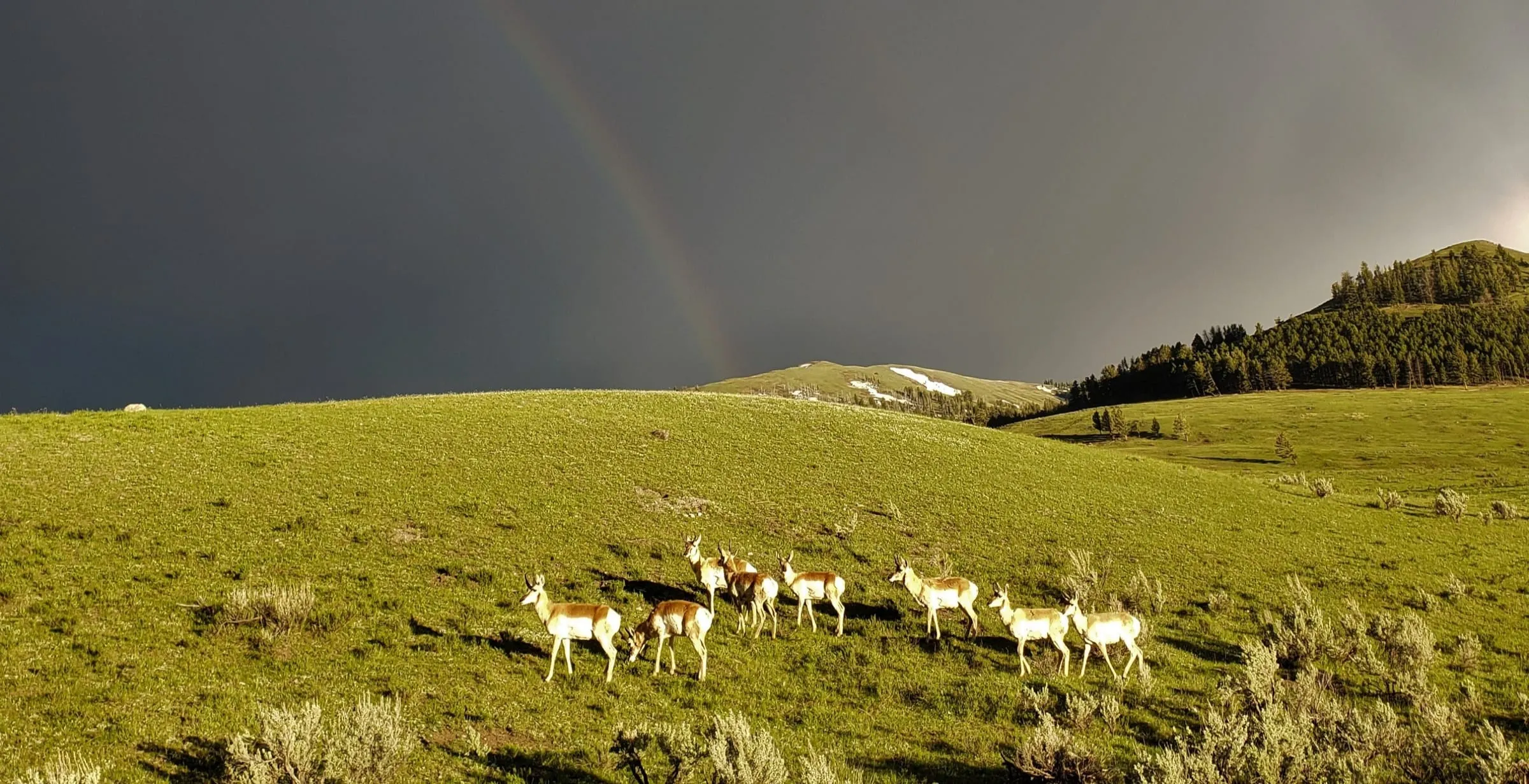
Pronghorn help make payroll.
179 local businesses from Cooke City to Livingston, standing up for the wild places that keep their doors open. Guides, lodges, saloons, ranches, galleries and a gas station or two. No party line. Just a business line.
The directory
Find a pledge business. (Collect them all.)
Showing all 179
- Guides and outfitters Angler's West Flyfishing Outfitters montanaflyfishers.com
- Guides and outfitters Animals Abound theanimalsabound.com
- Guides and outfitters Big Sky Backcountry Guides bigskybackcountry.com
- Guides and outfitters Brant Oswald Fly Fishing LLC brantoswaldflyfishing.com
- Guides and outfitters Broken Oar Outfitters brokenoaroutfitters.com
- Guides and outfitters Buffalo Roam Tours tripadvisor.com
- Guides and outfitters Casanova Guided Tours casanovaguidedtours.com
- Guides and outfitters Covered Ground Tours coveredgroundtours.com
- Guides and outfitters Dodge Guides facebook.com
- Guides and outfitters Fitpacking fitpacking.com
- Guides and outfitters Flying Pig Adventures flyingpigrafting.com
- Guides and outfitters Fresh Track Tours freshtrackstours.com
- Guides and outfitters Greater Yellowstone Excursions ynpexcursions.com
- Guides and outfitters Greenstone Girl
- Guides and outfitters In Our Nature Guiding Services in-our-nature.com
- Guides and outfitters Incredible Adventures incadventures.com
- Guides and outfitters Jackson Hole EcoTour Adventures jhecotouradventures.com
- Guides and outfitters Jackson Hole Wildlife Safaris jacksonholewildlifesafaris.com
- Guides and outfitters Kaul of the Wild Yellowstone Tours kaulofthewildtours.com
- Guides and outfitters Lamar Valley Touring lamarvalleytouring.com
- Guides and outfitters Let’s Go Adventure Tours & Transportation letsgotoursmt.com
- Guides and outfitters Meadowlark Guide Company meadowlarkguide.co
- Guides and outfitters Montana Fly Fishing Guides montanaflyfishingguides.com
- Guides and outfitters Montana Yellowstone montanayellowstonetours.com
- Guides and outfitters Mountain Man Guiding LLC mountainmanguiding.com
- Guides and outfitters Mountain Mule Transportation mountain-mule.com
- Guides and outfitters Nomadic by Nature instagram.com
- Guides and outfitters Roam Yellowstone Guiding roamyellowstoneguiding.com
- Guides and outfitters Silver Gate Guides silvergateguides.com
- Guides and outfitters Tilting Tripods Wildlife
- Guides and outfitters Touring Wonderland touringwonderland.com
- Guides and outfitters Walking Shadow Ecology Tours yellowstone.education
- Guides and outfitters Wild Bear Adventures facebook.com
- Guides and outfitters Yellowstone Adventure Tours adventuretoursofyellowstone.com
- Guides and outfitters Yellowstone Critters
- Guides and outfitters Yellowstone Guidelines yellowstoneguidelines.com
- Guides and outfitters Yellowstone Guiding Services
- Guides and outfitters Yellowstone Insight yellowstoneinsight.com
- Guides and outfitters Yellowstone Journeys yellowstonejourneys.com
- Guides and outfitters Yellowstone Llamas LLC yellowstonellamas.com
- Guides and outfitters Yellowstone Now yellowstonenow.com
- Guides and outfitters Yellowstone Productions Cinematography facebook.com
- Guides and outfitters Yellowstone Safari Co yellowstonesafari.com
- Guides and outfitters Yellowstone Ski Tours yellowstoneskitours.com
- Guides and outfitters Yellowstone Summit yellowstonesummit.com
- Guides and outfitters Yellowstone Trip Planning: Shauna Baron Guiding Services yellowstonetripplanning.com
- Guides and outfitters Yellowstone Wild Tours yellowstonewildtours.com
- Guides and outfitters Yellowstone Wildlife Guide Company yellowstonewildlifeguidecompany.com
- Guides and outfitters Yellowstone Wildlife Profiles yellowstonewildlifeprofiles.com
- Guides and outfitters Yellowstone Wolf Tracker wolftracker.com
- Guides and outfitters Yellowstone Wonders yellowstonewonders.com
- Guides and outfitters Your Life Nature yourlifenature.com
- Lodging Casita Deluxe airbnb.com
- Lodging Chico Hot Springs chicohotsprings.com
- Lodging Corral Burgers & Lodging corralvillas.com
- Lodging Dreamcatcher Tipi Hotel dreamcatchertipihotel.com
- Lodging Emigrant Cabins emigrantcabins.com
- Lodging Emigrant Peak Loft airbnb.com
- Lodging Erik’s Ranch eriksranch.org
- Lodging Hot Tub Under the Cottonwood Canopy
- Lodging Jardine Retreat jardineretreat.com
- Lodging Murray Hotel murrayblock.com
- Lodging Paradise Gateway Bed & Breakfast paradisegateway.com
- Lodging Paradise Property Outfitters
- Lodging Pitch Yellowstone pitchyellowstone.com
- Lodging Raich Montana Properties tracyraich.com
- Lodging Reedfly Lodging reedfly.com
- Lodging Rendevous Site
- Lodging Rivers Edge Cabins linktr.ee
- Lodging Rocking RV LLC
- Lodging Sage Lodge sagelodge.com
- Lodging Silver Gate Lodging silvergatelodging.com
- Lodging Tiny Town Campground tinytowncampground.com
- Lodging Upriver Yellowstone upriveryellowstone.com
- Lodging Wanderlust Haven vrbo.com
- Lodging Yellow Stonefly Cabins yellowstoneflycabins.com
- Lodging Yellowstone Gateway Inn yellowstonegatewayinn.com
- Lodging Yellowstone Riverside Cabin yellowstoneriversidecabin.com
- Food and drink Bears Brew facebook.com
- Food and drink Blue Goose Saloon twobit.city
- Food and drink Chico Hot Springs Dining chicohotsprings.com
- Food and drink Coral Burgers corralvillas.com
- Food and drink Follow Yer' Nose BBQ followyernosebbq.com
- Food and drink Gil's Goods murrayblock.com
- Food and drink Morning Glory Coffee & Tea, Inc. morningglorycoffee.net
- Food and drink Sage Lodge Dining sagelodge.com
- Food and drink Sagebrushers & Savages sagebrushersfood.com
- Food and drink The Gourmet Cellar gourmet-cellar.square.site
- Food and drink The Murray Bar murrayblock.com
- Food and drink The Royal Wulff Tavern rangeriderslodge.com
- Food and drink Wonderland Cafe & Lodge wonderlandcafeandlodge.com
- Food and drink Zac's Montana Kitchen cookingontherange.com
- Retail and gas Boheme Apotheca
- Retail and gas Buchanan Expressions
- Retail and gas Dan Bailey's Outdoor Company danbaileys.com
- Retail and gas Deep Creek Outdoor facebook.com
- Retail and gas Elk River Books elkriverbooks.com
- Retail and gas Gardiner Sinclair Gas Station (Dinolube) yellowstonedinolube.com
- Retail and gas Parks' Fly Shop parksflyshop.com
- Retail and gas Stop The Car Trading Post facebook.com
- Retail and gas The Smoking Bear smokingbearmt.com
- Retail and gas Traci jo Designs tracijodesigns.com
- Retail and gas Wheatgrass Books wheatgrassbooks.com
- Photo, film and art 45 North Films 45northfilms.com
- Photo, film and art Arthouse Billy Studios arthousebillystudios.com
- Photo, film and art BioPics
- Photo, film and art Brian Creek Photography, LLC briancreek.photography
- Photo, film and art Bridger Peaks Photography createphotocalendars.com
- Photo, film and art Buchanan Expressions
- Photo, film and art Chocolate Moose Images chocolatemooseimages.com
- Photo, film and art Clyde Aspevig Art clydeaspevig.com
- Photo, film and art Forosix Photography
- Photo, film and art Hastings Photography hastingsphotography.mypixieset.com
- Photo, film and art Kate Ochsman Photography kateochsman.com
- Photo, film and art Kyle Dudgeon Creative LLC kyledudgeoncreative.com
- Photo, film and art Landis Wildlife Films
- Photo, film and art Melissa Lipton Photography melissaliptonphotography.com
- Photo, film and art Muddy Mammoth Studios muddymammothstudios.com
- Photo, film and art Old Wolf Photography oldwolfphoto.smugmug.com
- Photo, film and art Patrice Dello-Russo Fine Art Studio patricedellorusso.com
- Photo, film and art Roche Jaune Pictures, Inc.
- Photo, film and art Sandra Lee Photography investinnature.org
- Photo, film and art Soul Dog Studio
- Photo, film and art The Al Agnew Collection alagnewmerch.com
- Photo, film and art Touring Wonderland Photography touringwonderland.com
- Photo, film and art Trent Sizemore Photography, LLC trentsizemore.com
- Photo, film and art Visionhawk Films visionhawkfilms.com
- Photo, film and art Wild Love Images facebook.com
- Photo, film and art Wildlife Along The Rockies
- Photo, film and art Wolfcat Films woofcatfilms.com
- Photo, film and art Yellow Brick Films
- Photo, film and art Yellowstone Wild the Gallery yellowstonewild.com
- Photo, film and art Yellowstone's Wild World, LLC facebook.com
- Photo, film and art Your Life Nature LLC yourlifenature.com
- Ranches and farms Anderson Ranch thecommongroundproject.us
- Ranches and farms B Bar Ranch bbar.com
- Ranches and farms Barney Creek Livestock barneycreek.com
- Ranches and farms Highland Harmony Farm highlandharmonyfarm.com
- Ranches and farms MJS Ranch fayranches.com
- Ranches and farms PMD Ranch
- Everybody else A Woman of Wonderland goodreads.com
- Everybody else April Christofferson, Author aprilchristofferson.com
- Everybody else Axis Initiative
- Everybody else Bozeman Green Build bozemangreenbuild.com
- Everybody else Clean Slate Tile
- Everybody else Ecology Project International ecologyproject.org
- Everybody else Explore Livingston Coalition explorelivingstonmt.com
- Everybody else Full Circle Biofuels fullcirclebiofuels.com
- Everybody else Grizzly Systems, Inc grizcam.com
- Everybody else Ilona Popper, Author ilonapopper.wordpress.com
- Everybody else Kendeda Fund kendedafund.org
- Everybody else Key Montana Property Management keymontana.com
- Everybody else Law office of Michelle Uberuaga linkedin.com
- Everybody else Livingston Center for Art and Culture livingstoncenter.org
- Everybody else LongHorn Maintenance
- Everybody else Mighty Fine Time facebook.com
- Everybody else Montana Freshwater Partners freshwaterpartners.org
- Everybody else Montana Grizzly Encounter grizzlyencounter.org
- Everybody else Mountain Air Printing
- Everybody else Museum of the Rockies museumoftherockies.org
- Everybody else Old Faithful Detailing facebook.com
- Everybody else Optics Yellowstone opticsyellowstonellc.com
- Everybody else Outside Bozeman outsidebozeman.com
- Everybody else Paul Lee Kupfer Band paulleekupfer.com
- Everybody else Quality Painting
- Everybody else Rick Lamplugh, Author goodreads.com
- Everybody else Rick McIntyre, Author rickmcintyre.com
- Everybody else Romeo Bravo Software rbsgo.com
- Everybody else Sammy Sews
- Everybody else SeaBird Strategies LLC seabirdfin.com
- Everybody else Teton Strong Communications tetoncommunications.com
- Everybody else Tom Miner Basin Association tomminerbasinassociation.org
- Everybody else Visions West Contemporary visionswestcontemporary.com
- Everybody else Vital Impacts vitalimpacts.org
- Everybody else Wingville Consulting facebook.com
- Everybody else Yellowstone Now! yellowstonenow.com
- Everybody else Yellowstone Reports yellowstonereports.com
- Everybody else Yellowstone Wildlife Sanctuary yellowstonewildlifesanctuary.org
- Everybody else Yellowstone Wolf Family Tree yellowstone-wolves.com
- Your trade here Your business, here. Sign the pledge. The coalition says hello, then your card goes up.
Our mission
To become the standard for how rural gateway communities protect natural resources, sustain local livelihoods, and balance growth with the integrity of the wild lands.
The Land Works for Us—So We Invest in the Land
Wild Livelihoods strengthens the northern Greater Yellowstone economy by investing directly in the natural resources that sustain it. Tourism is the dominant economy here, generating $1.3B a year for businesses across Yellowstone Country. Seeing wildlife is a top reason people come. We make it easier for local businesses to voluntarily fund conservation, support responsible recreation, elevate community values, and advance policies that keep wildlife, working lands, and rural communities healthy. We honor fair-chase, leave-no-trace, and the responsibility to pass on a healthier landscape to future generations. By partnering with ranchers, agencies, and gateway communities, and by advocating for public-land decisions that reflect the importance of our tourism economy, we work to keep the northern Greater Yellowstone wild, productive, and resilient for generations to come.
Sources: Out-of-state visitor spending in Yellowstone Country, the five counties at Yellowstone's north door, 2024/2025 average: ITRR 2025 Summary. Reasons to visit: 30% of visitors entering at Gardiner came mainly to see wildlife (RSG 2016 Yellowstone visitor study, via the 2022 Park County Tourism Study). Details on Wildlife Economics.
- 01 Visitors come here for wild country. We keep it wild, and we keep it working.
- 02 Habitat first. Clean water, open land, room to roam, a fair chance for the animals that share it.
- 03 Wildlife policy built on science, not on whoever yells loudest at the hearing.
- 04 We give back more than the minimum. Then we say so, right here, where you can check.
Where the herd ranges
One river. One road. Four towns.
- LivingstonThe railroad town
- EmigrantParadise Valley
- GardinerYellowstone's north entrance
- Cooke CityEnd of the road
For visitors and the tourism trade
Tired of wildlife being a political football?
Vote with your wallet.
The wolves, the elk and the grizzlies do not care who you voted for. Neither do we. Book the guide, the cabin and the dinner table with businesses that protect what you came to see, and tell them why.